
Getting started
You Were Laid Off. Your Skills Weren't.

If you were just laid off, first: I am sorry. Not the polite kind of sorry. The real kind. A layoff is not a performance review. It is a company deciding, in a spreadsheet, that a role costs more than it wants to spend this quarter. That decision can take your income, your routine, and a piece of how you see yourself, all in a single meeting you did not schedule.
So before any advice, this: what happened is not a verdict on your worth. You are allowed to be angry, scared, and tired. You are allowed to not have a plan yet.
And when you are ready, even a little, here is the quiet truth underneath all of it. The skills that made you valuable to that company did not leave when your badge stopped working. They are still yours. The only thing that changed is who gets to decide what they are worth. For the first time, that person can be you.
The fear is real. Let's name it.
Most people do not hesitate to work for themselves because they lack skill. They hesitate because of three very human fears:
- Money. A paycheck is predictable. Starting something is not, at least not at first.
- Identity. "I work at [Company]" is a sentence that answers a lot of questions at parties. "I'm figuring it out" feels naked.
- Legitimacy. A quiet voice says, "Who am I to charge for this?"
None of these mean you should not do it. They mean you are a normal person standing at the edge of something new. Let's make the edge smaller.
You do not need a business. You need a first client.
The word "business" is heavy. It sounds like an LLC, a logo, a five-year plan, and a loan. Skip all of that for now. What you actually need first is one person who pays you for one thing you already know how to do. That is the whole starting line. Everything else can come later, or never.
The exercise: your Comeback Worksheet
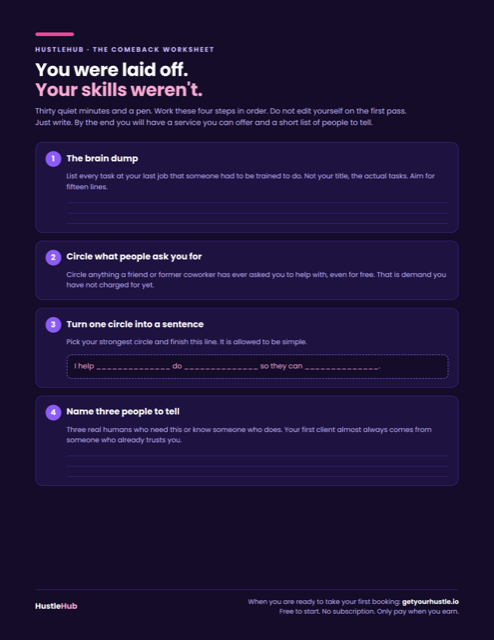
Give yourself 30 quiet minutes and a piece of paper. Work through these four steps in order. Do not edit yourself on the first pass. Just write.
Step 1: The brain dump. List every task you did at your last job that someone had to be trained to do. Not your title. The actual tasks. "Built the onboarding deck." "Untangled the budget every month." "Coached three new hires." "Ran the event without it falling apart." Aim for fifteen lines.
Step 2: Circle the ones people ask you for. Go down your list and circle anything a friend, a former coworker, or a neighbor has ever asked you to help with, even for free. Those are not hobbies. Those are demand you have not charged for yet.
Step 3: Turn one circle into a sentence. Pick the strongest circle and finish this line: "I help [who] do [what] so they can [result]." For example: "I help new managers run their first team so they stop feeling like impostors." That sentence is your first service. It is allowed to be simple.
Step 4: Name three people to tell. Not the whole internet. Three real humans who either need this or know someone who does. Your first client almost always comes from someone who already trusts you.
That is it. Four steps. If you did them honestly, you now have a service and a short list. That is further than most people get in a month of worrying.
Get the free Comeback Worksheet
The one-page version of the exercise above, yours to print.
Download the worksheetWhat about the money gap?
Being honest: your first month of working for yourself will probably not replace your old salary. That is not failure, that is a starting line. The goal early on is not a full income. It is proof: one person paying you for the sentence in Step 3. Proof changes how you feel faster than anything else, because it answers the legitimacy fear with evidence instead of a pep talk.
Keep your costs near zero while you look for that proof. You do not need a website builder subscription, a scheduling tool, an invoicing tool, and a payments app all charging you before you have earned a cent. Start with what is free, and only pay for tools once they are helping you get paid.
When you are ready to take your first booking
When you get to the point of "okay, someone wants to book me, now what," that is where HustleHub can help, and it is the reason we exist. You can set up a simple page that shows what you offer, share one link so a client can pick a time and pay, and send a clean invoice. HustleHub is free to join, so there is no bill sitting on your chest while you are still finding your footing. You can see how the pricing works at getyourhustle.io/pricing.
That is the whole idea: the tools should not cost you money before you are making money. You can start at getyourhustle.io when you are ready, and not a moment before.
You are not starting from zero
A layoff feels like a door slamming. But you are not walking out empty-handed. You are walking out with everything you learned inside, and now you get to decide what it is worth. That is not a consolation prize. For a lot of people, it turns out to be the best thing that was ever done to them, even if it did not feel that way on the worst day.
Do the worksheet. Tell the three people. Take the first booking. One step at a time, you build something that no quarterly spreadsheet can ever take away from you again.
HustleHub: get booked, get paid. Free to join. Join the Founding 100.